
Grant PUD donation program gets new name
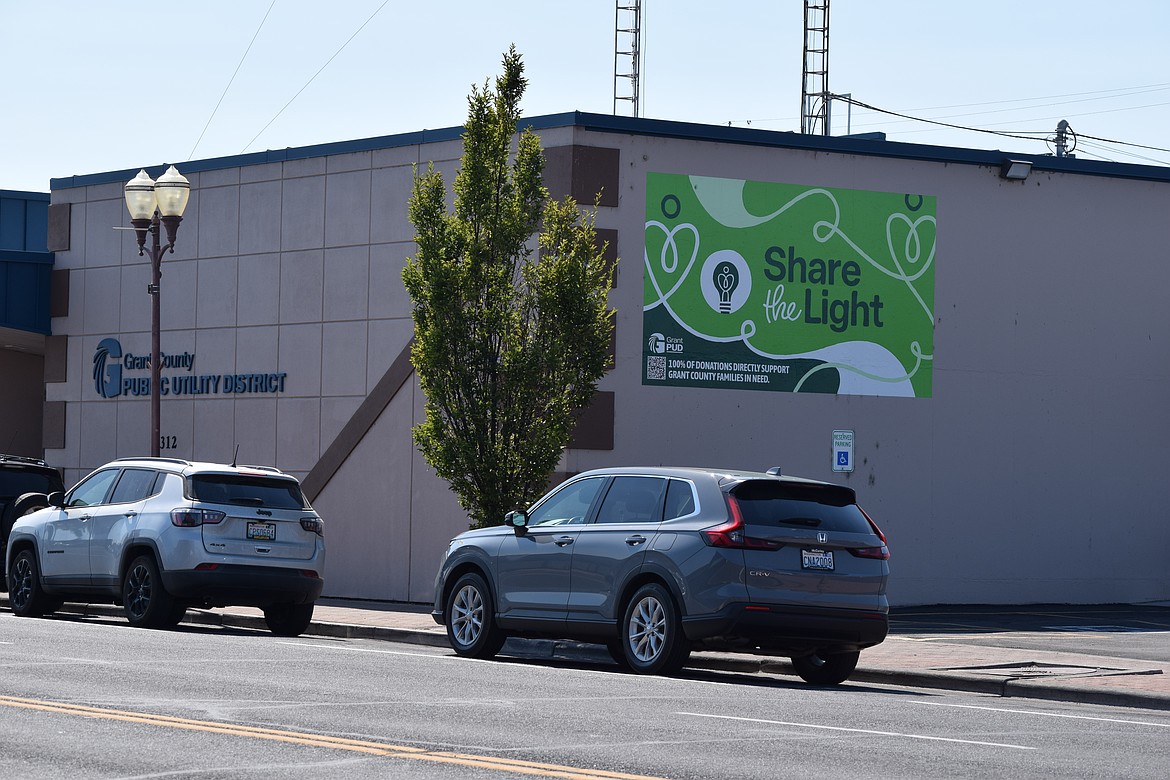
The Grant County Public Utility District has changed the name of its Share the Warmth program to Share the Light. The branding change comes as the PUD has realized hotter summers have created a need for energy assistance year-round. Above, the Grant PUD building on Third Avenue in Moses Lake sports a new sign promoting the program.
R. HANS MILLER/COLUMBIA BASIN HERALD
EPHRATA — Because it’s used year-round, the Grant County Public Utility District has renamed its donation program. “Share the Warmth” is now “Share the Light.” Cary West, the PUD’s senior manager of customer solutions, said the name change better reflects the intended use.
“Probably back in the 1980s is when we (started) Share the Warmth, but we’ve rebranded it to promote it throughout the year,” West said. “When it was Share the Warmth, it was promoted more during the winter months. But we have summer peak (usage) and winter peak usage, so the need is there year-round.”
Money from the Share the Light program is used to help qualifying PUD customers pay their electrical bills. The PUD will also work with customers who have fallen behind in their payments to get any debt paid within a reasonable time.
Utility district customers can donate to the fund via their monthly bill; PUD officials have also added a QR code for direct donations. All donations go to help people facing financial challenges.
There are non-PUD options for help paying utility bills for people who qualify, West said. Among them is the energy assistance program of the Opportunities Industrialization Center — or OIC — of Washington, which is funded through federal and state sources. More information is available through the OIC office, 509-755-7100.
Customers can qualify for up to $300 in Share the Light assistance over a rolling 12-month period, West said. Regardless of whether or not customers qualify for assistance, West said PUD officials will work with people who have fallen behind and help them catch up in a reasonable time.
“Let’s have a conversation with the customer,” West said.
The PUD offers a payment plan of up to 30 days.
“If a customer can’t pay today, but they can pay in two or three weeks, we can move that (date) out through a pay plan, and we do that,” he said.
Qualifying customers may schedule debt repayment for up to six months, where a portion of the outstanding balance is added to the monthly bill. In both cases, there’s no interest, he said.
Any outstanding balance must be paid, he said.
“We have that conversation with the customers, making sure that they’re aware that if we make a deferred payment plan on the account, we’re going to hold you to it,” West said. “We’re not allowed, by state law, to give out free power. That’s a mandate we have with being a public organization.”
People who are past due on their PUD accounts are notified by letter, he said. If there’s no response, the customer receives a phone call the day before the scheduled disconnection.
“With the PUD being proactive that way, it really reduces the amount of disconnections for nonpayment by about 50%. If we’re able to make contact with those customers, our ability to collect payment or make arrangements is so beneficial. And it really helps the customer with their experience with the PUD,” West said.
The PUD is conducting a pilot program using a payment kiosk that is accessible when the PUD office is open. The kiosk takes cash payment as well as checks and credit or debit cards.
“Our long-term goal is to have payment kiosks at retail locations,” he said.